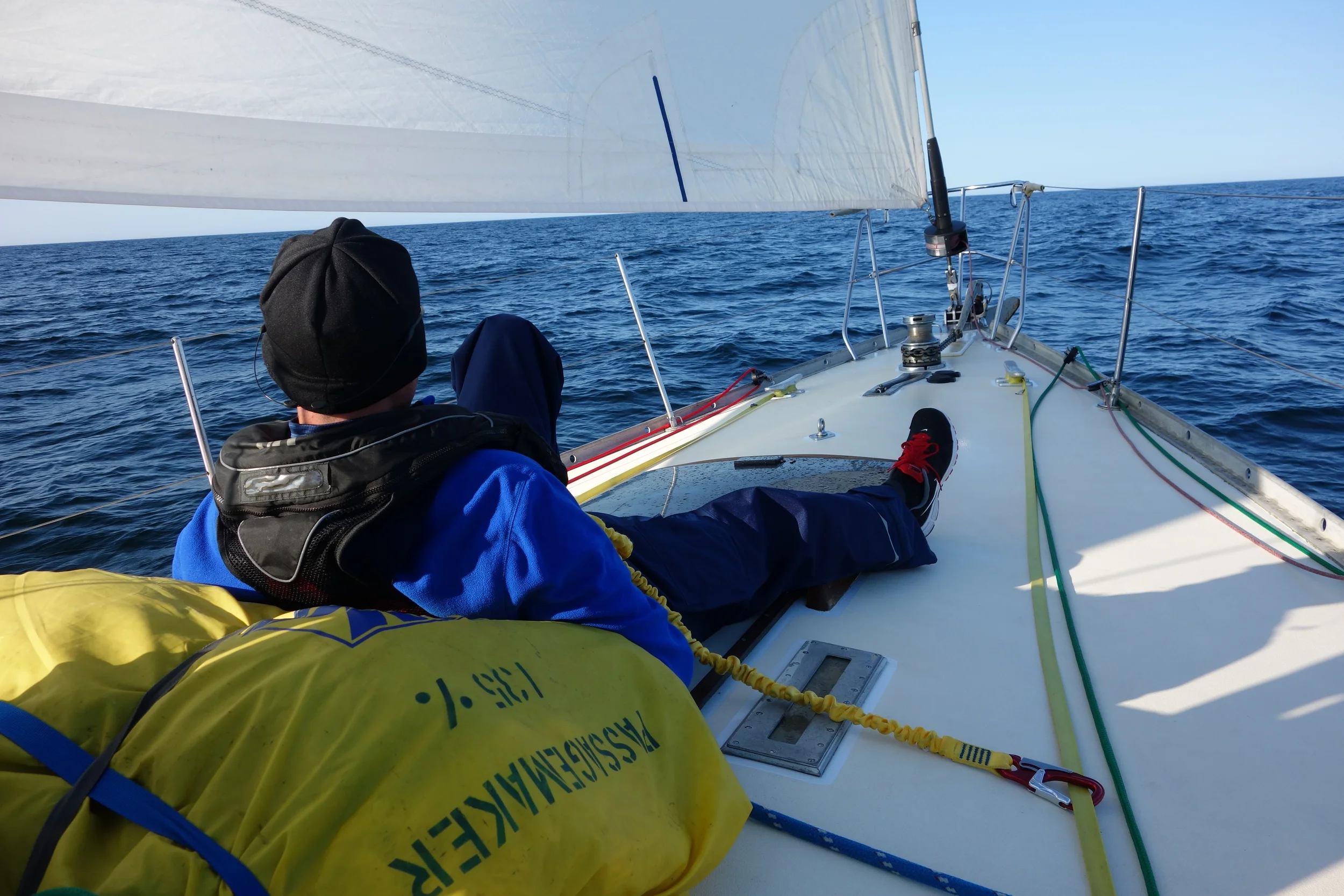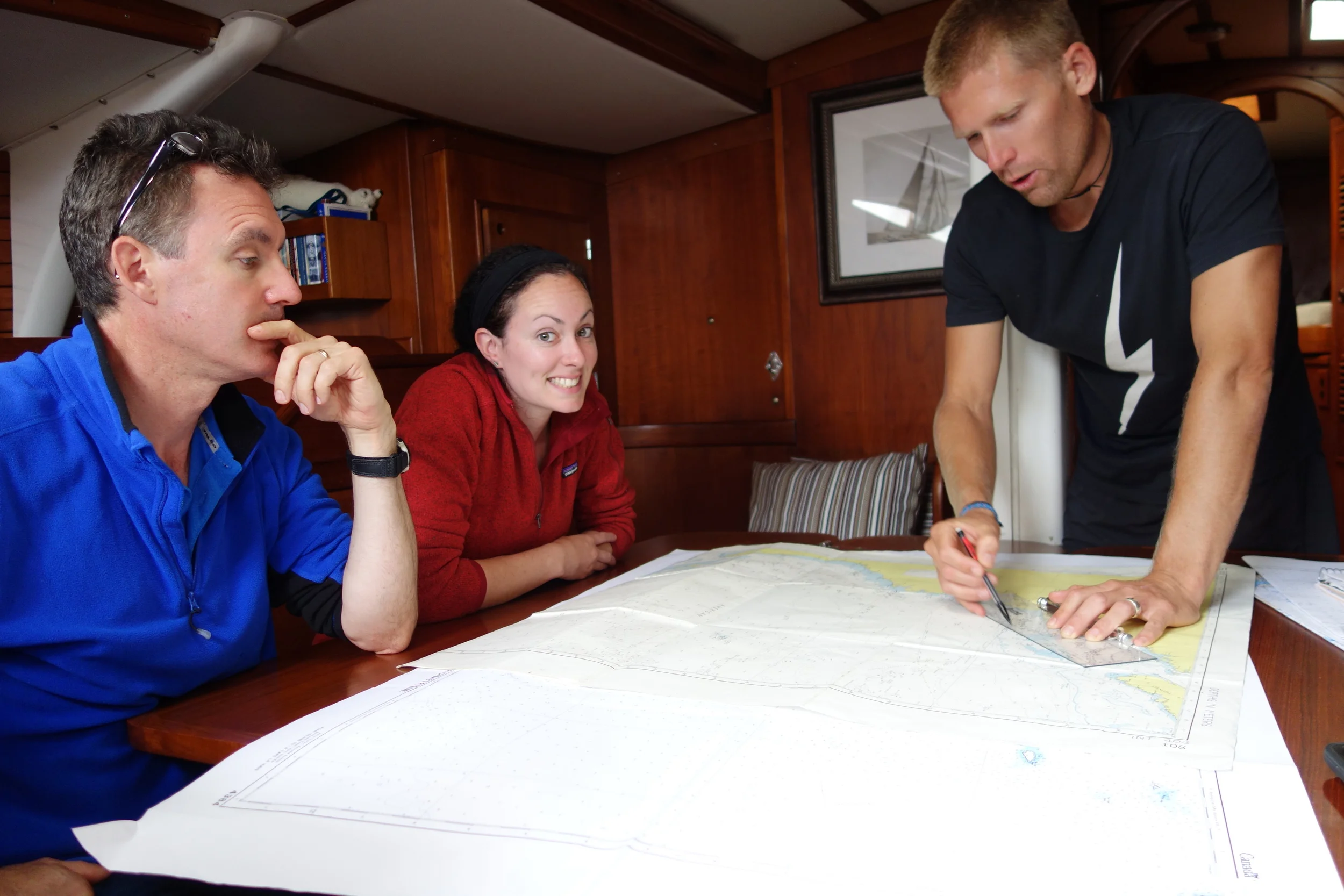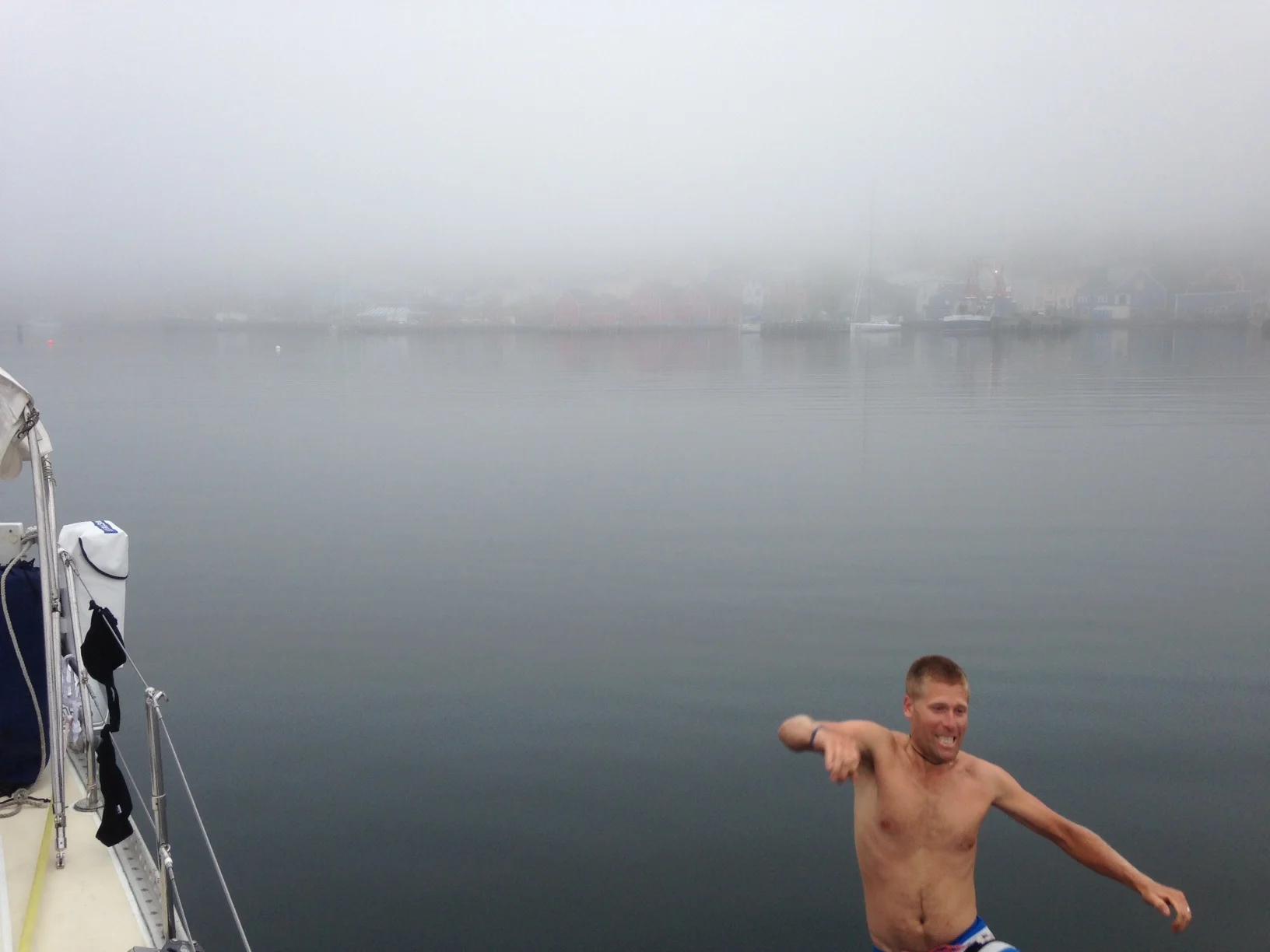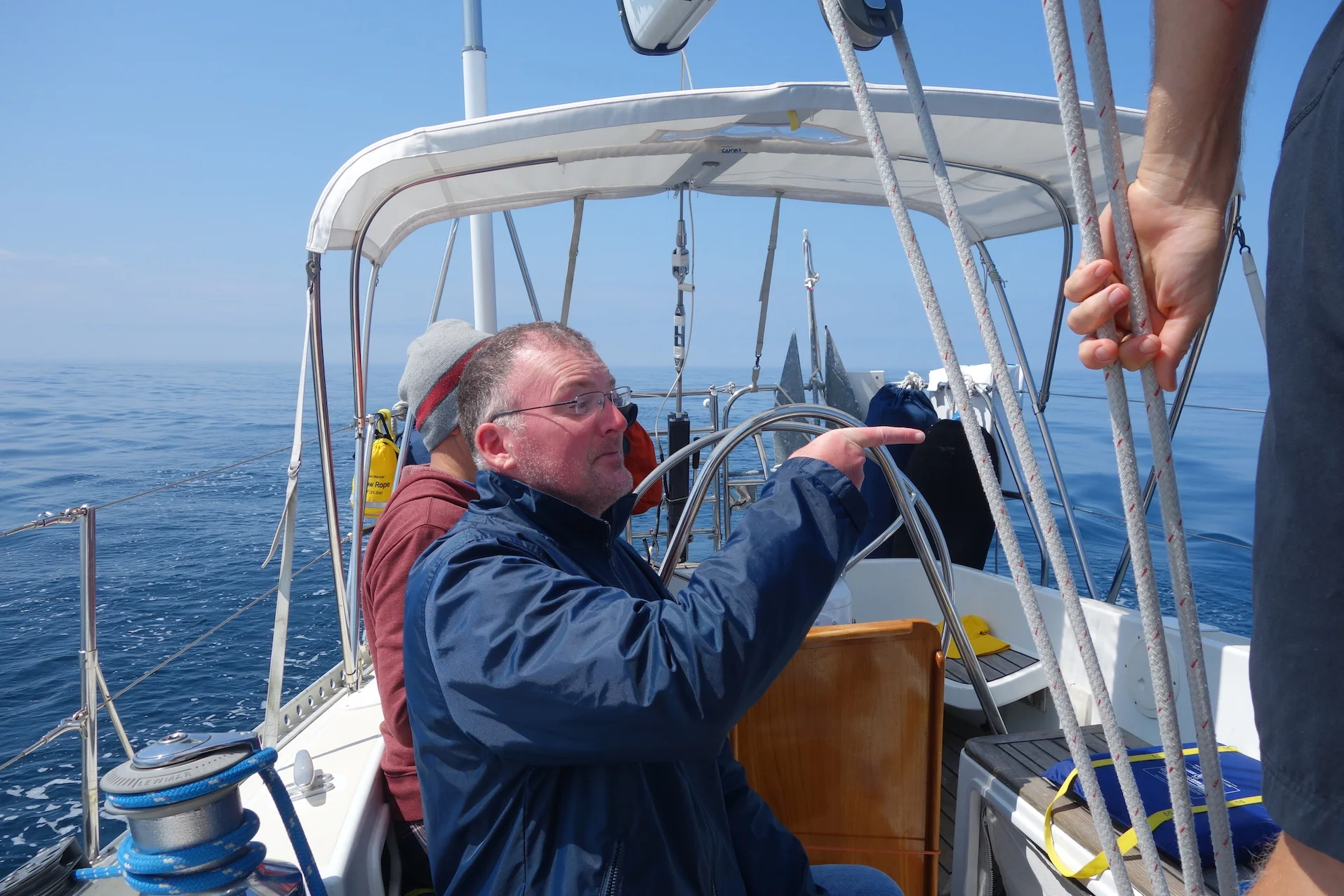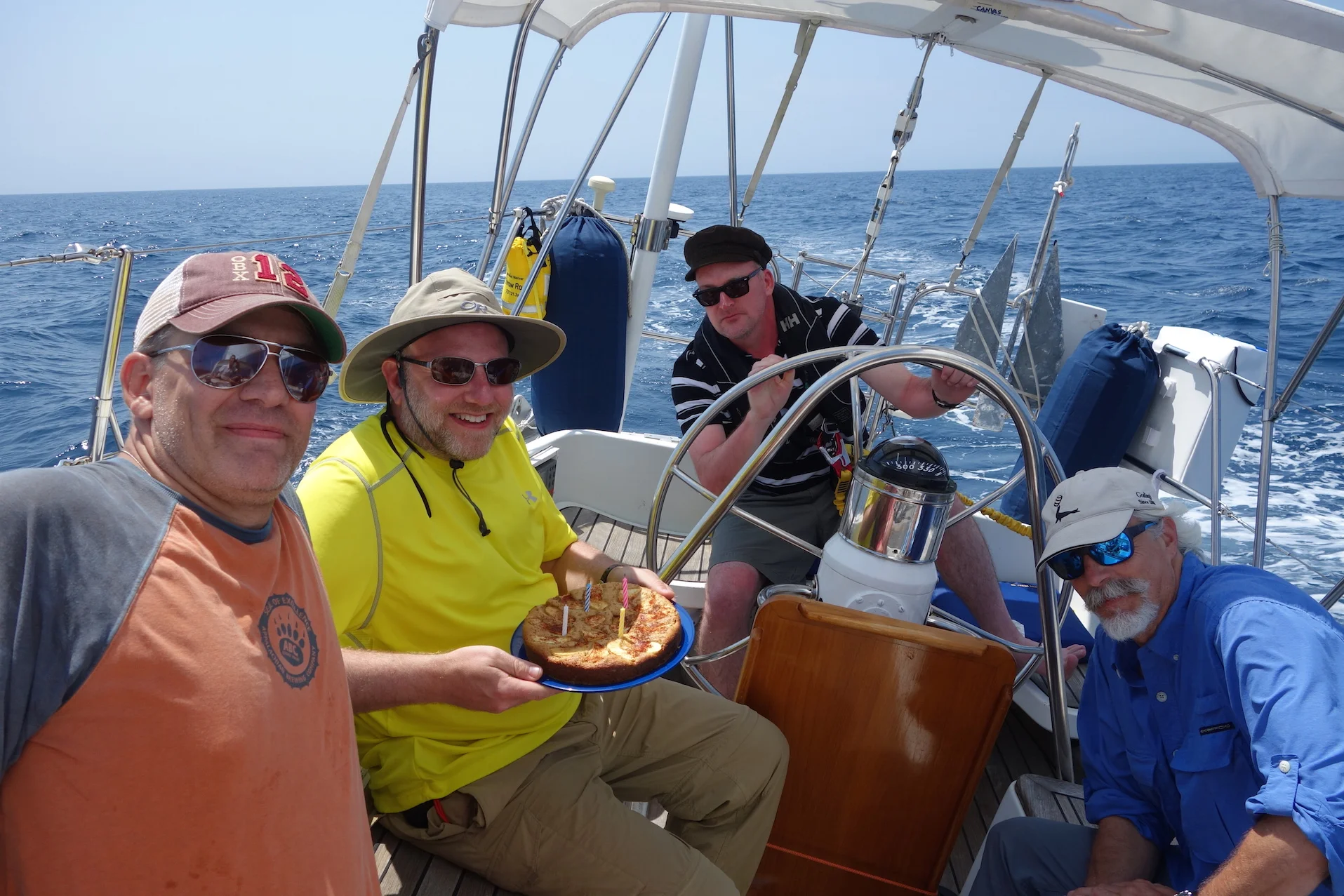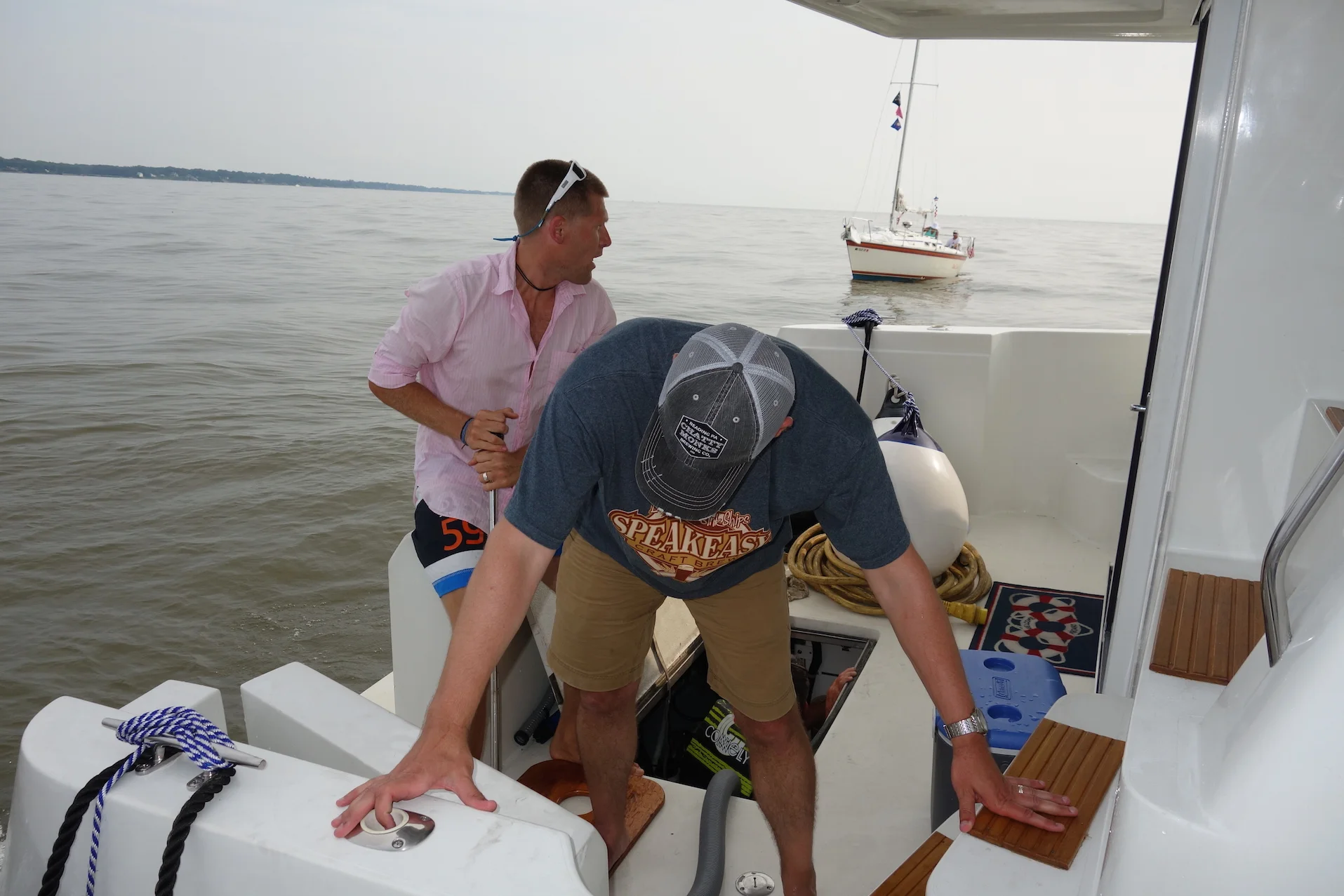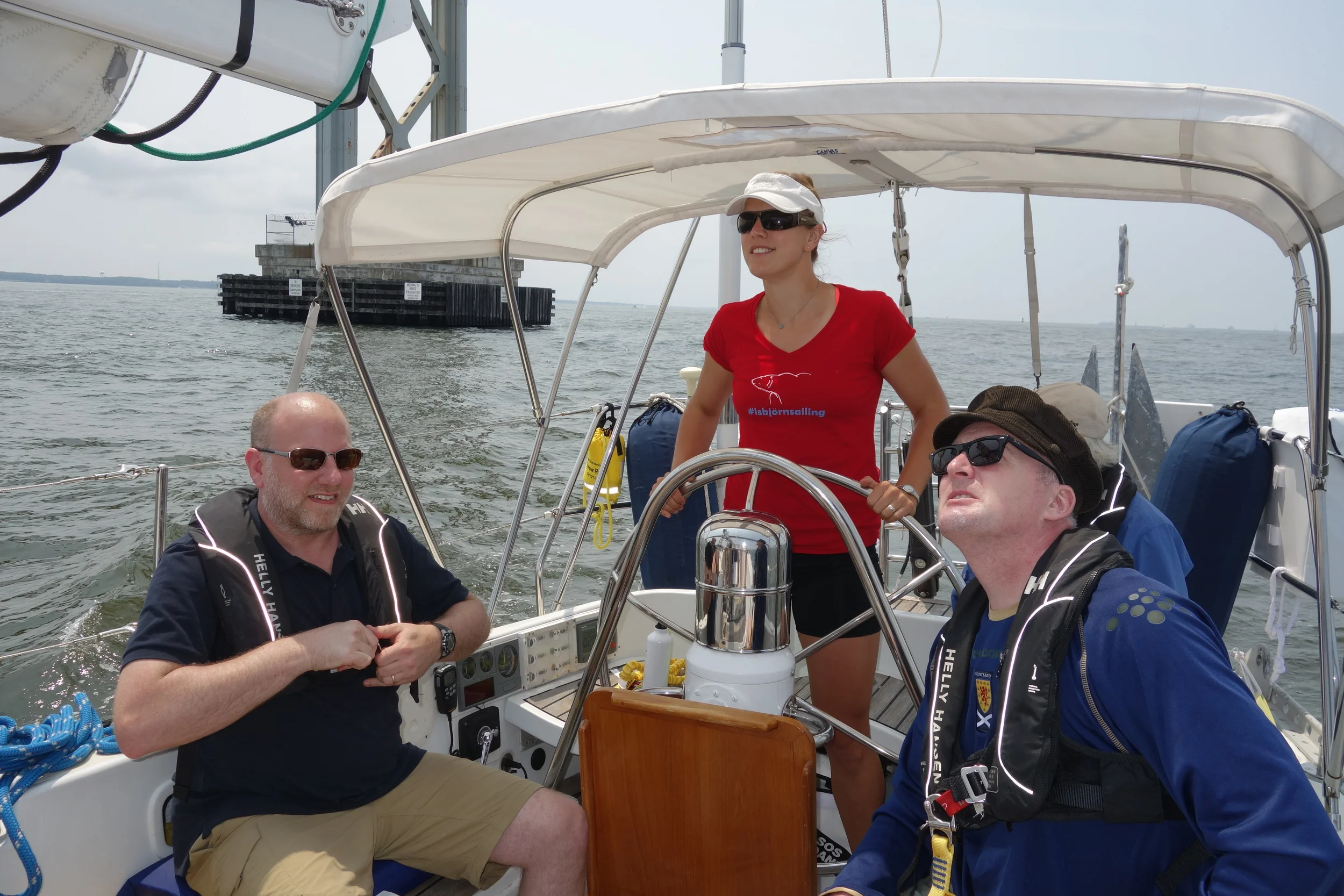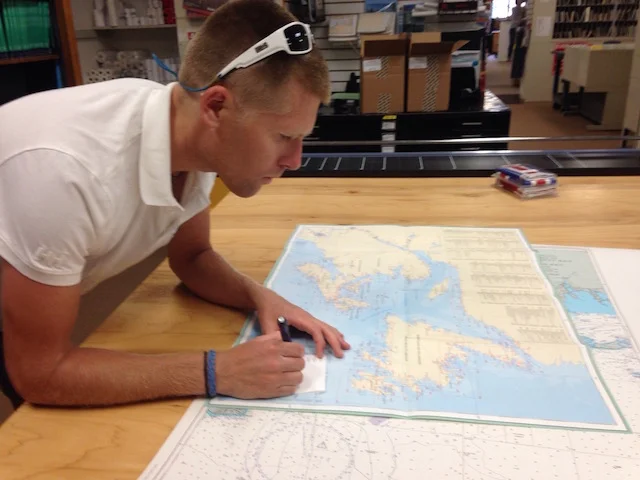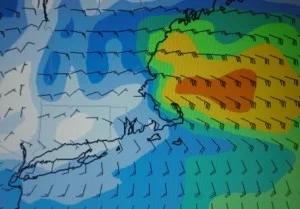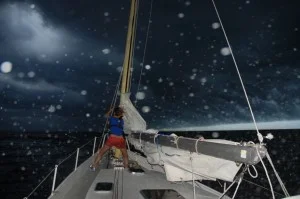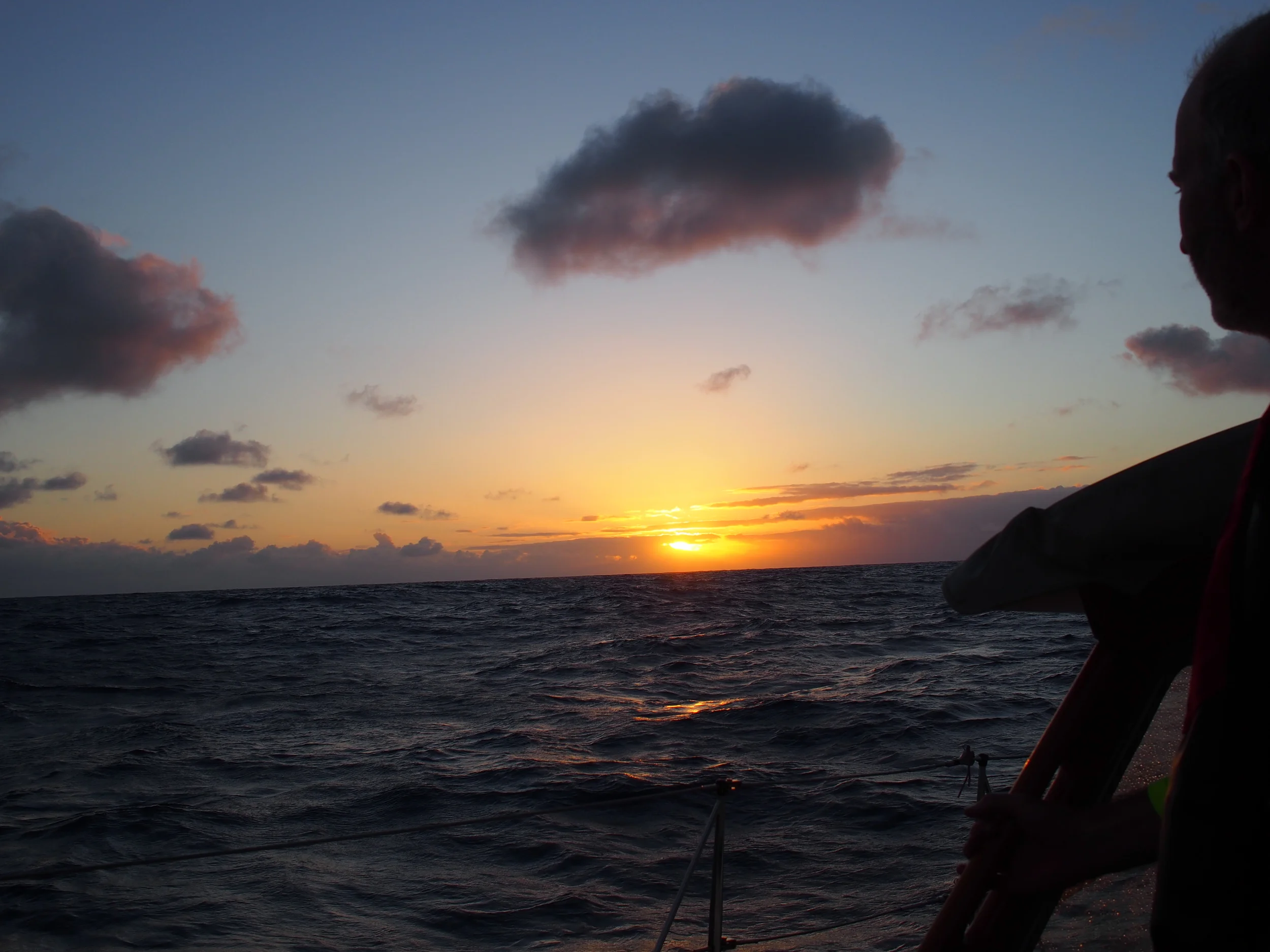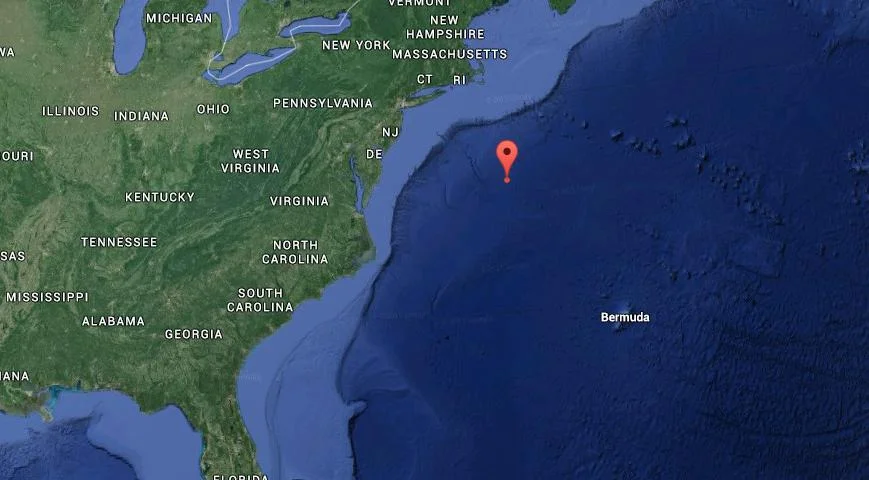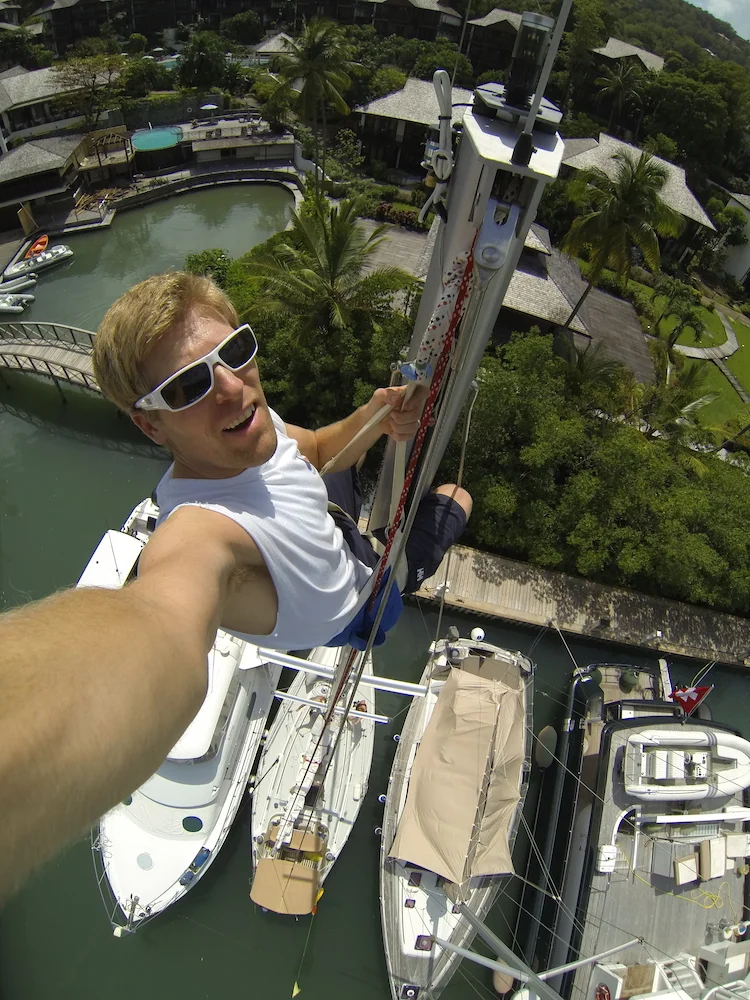


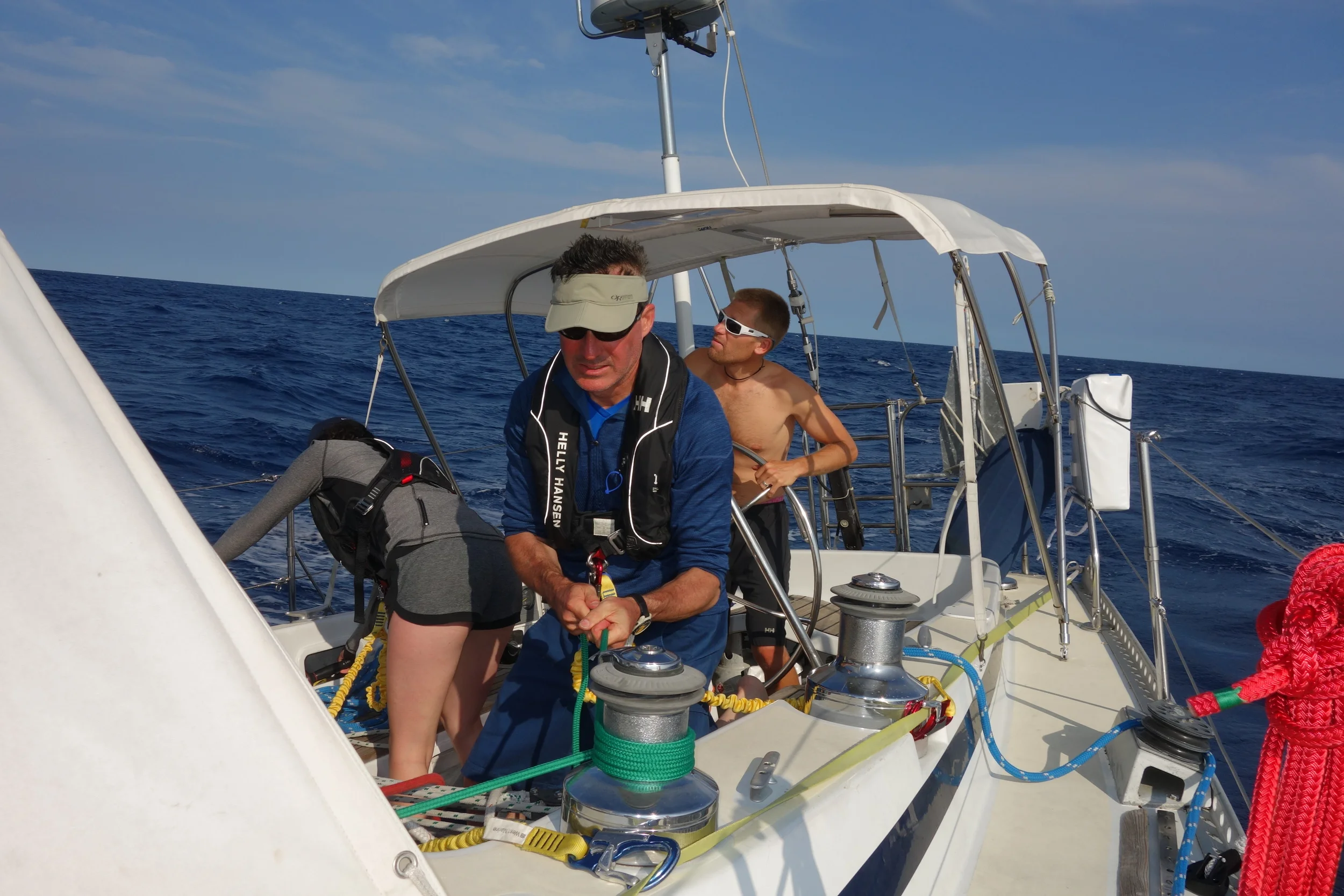
Upwind sailing highlighted the last 36 hours of our offshore passage as we beat down the NJ coastline. Thanks to Rory Finneran for managing the blog!
Seeing the ice in clear skies was a hell of a reward for the heavy weather yesterday. Thus far we’ve stopped to admire two big bergs from close range, bringing in ICEBEAR under power (the wind, after all that fuss, shut down completely around 1200 noon as we rounded Cape Race) to within a hundred yards or so. I put the drone up to get a bird’s eye view, and the crew stopped to admire the beauty of nature’s most striking sculpture. Both bergs we stopped for had at some point in their decay rolled, for the tops of them were pure white and smooth as marble, highlighted in spots by deep turquoise cracks where they’d broken apart and re-frozen during their lifespan.
This has been all over my Facebook page the past couple of days, thanks to Kevin King, who crewed with us and took the footage. When the whale first approached, we were in awe, and just enjoyed his company. Kevin wanted to film right away, but I kind of discouraged him - if you're always behind the camera, you can't appreciate what's right in front of you. But the whale kept coming back! I was afraid jamming the camera down in the water might scare him off (he thinking it might be a harpoon!), but eventually we gave it a go. I think it was worth it!
This was written yesterday, posted today (Monday). Photos below.
We arrived into St. Croix yesterday afternoon after what I think was probably the easiest passage I’ve ever done. We sailed on starboard tack the whole way, broad reaching in anywhere from 8-25 knots, and only motoring for one hour, through a pretty calm spot when the sails were banging around and we had to roll up the jib.
I will have WAY more to say about this in due time, but wanted to post it immediately. Thanks to Dave for sharing - you know who you are. Might we have finally reached a tipping point when it comes to taking offshore sailing seriously, instead of a ride to warmer weather?
I just had an interesting email exchange with a friend whose in the (years-long) process of outfitting his boat for extended ocean cruising. The boat is similar to Arcturus, and we have similar ideas about things, and somehow got in touch a few years back. Anyway, we've had several of these types of exchanges. I won't say who it is out of respect for his privacy, but I want to publish my response to his latest email about rigging, sails and engines. I'll preface each section with what I'm about to discuss, but won't include anything specific that he's emailed me. What's your take?
Who cares about Greenland and why is the Ocean Research Project team going there? About 90% of the island is covered in ice and the people and animals who live there rely on it staying froze. They live along the rocky fringes separated around the island by partially frozen fjords and towering dynamic marine terminating glaciers where their means of survival, traveling and hunting by dogsled is threatened. When the ice sheet eventually melts at least 21 feet of sea level rise will occur globally, but when? Our observations will help scientists from NASA to determine the stability of the ice sheet and predict when the water will be displaced.
Onboard the R/V Ault, Captain Matt and I are sailing to Greenland and are currently in the North Atlantic Ocean off Canada’s, Newfoundland where we have entered a maze of small ice bergs not far from where the Titanic cruise liner met a berg face to face. It is scary to sail to a near frozen world where you have to rely on yourself to survive but it is even scarier to ignore climate change and the impact it is having not just on the Arctic but on the entire planet. Just imagine, you could fill the Chesapeake Bay up 3 times each year with how much water is melting off of Greenland. How much of an impact does human civilization have to do with these changes?
Matt and I take turns sailing the boat, we help each other out when things get tough. 5 hours on, then 5 hours off, days go by and time becomes a blur especially as you head closer to the Arctic. As we head North eventually the sun will not set during the summer months. The tilt of the Earth’s axis and its position around the sun causes daylight around the clock. We have already climbed 10 degrees of latitude heading north, 16 more and we will be in the Arctic and if environmental circumstances allow we will study the climate change impacts of Smith Sound at 78 degrees North.
We aim to survey narrow fjords with rapidly melting glaciers especially in the less explored fjords of Melville Bay. There are dozens of fjords that are often too narrow for research planes to operate and to shallow for large research vessels to navigate safely. We are trying to find where the warm water is coming up and at what depth. Warm water is thought to be coming all the way from the North Atlantic Ocean traveling up over the shelf, through connecting deep water canyons, entering the glacial fjords only to eat away and melt the underbelly of the glaciers that stick out over the water. We will survey these uncharted regions to observe if this warm water is really coming up from the depths.
Cautiously we will approach glaciers to periodically drop a sensor, a RBR ltd. CTD (conductivity, temperature, depth device) all the way to the bottom to help identify where the warm water is and how fresh it is considering the adjacent glacial melt activity.
Since we left Annapolis, Maryland about 3 weeks ago we have recorded much about the ocean’s surface along the eastern seaboard such as: how much carbon is present, how salty it is, and what the temperature is. We have two automatic sampling systems installed aboard the R/V Ault to manage; an ocean carbon sampling Smithsonian pCO2 system and RBR’s thermosalinograph which mainly measures sea surface salinity and temperature. Why should we measure ocean carbon, salinity and the temperature of the surface of the ocean from a temperate to polar climate?
Avannaarsua, (Greenlandic translation: To the far North)
Nicole
My dad decided to join us at the last minute. As I write, I'm back, yet again, at the Sweet Indulgence Cafe in Lunenburg, waiting for him to arrive by taxi from the airport. Isbjörn is on anchor in the harbor, with Mia and Rachel aboard just chilling out. Matt is somewhere in town doing a last-minute wander.
We're just hours from departing Lunenburg now for the return passage to Annapolis, and Tropical Storm Claudette is making me re-think our departure plans. Matt, one of our crew, went to the Fisheries Museum this morning, and it's all the tour guide was talking about. I had seen a small depression on the GRIBS yesterday, but apparently sometime this morning it officially got a name.
Of course one of the greatest things about ocean voyaging is exploring your landfall! My dad and I used to wonder, especially after particularly challenging passages, if we did it for the sailing, or did it for the payoff at the other end. I’m still not sure there is a clear answer to that. It’s obvious a bit of both, and the challenge of getting to that far-off land under your own effort over such a comparatively long time is what makes it so cool, and so unique in our modern time. The average air traveler will never have any concept of how large the world actually is. We ocean sailors know better.
I love sailing into a harbor, especially at night. Moitessier once wrote that he prefers sailing into a harbor at night because nobody is watching, and you don’t have to worry about folks thinking you’re showing off. Sometimes you are, of course, but to me, it’s more about the joy and challenge of coming in under sail than anything else.
Sailing from the hot & humid Chesapeake northeast past New England & on towards Canada has been exceptionally exciting in terms of the changing weather and the cooling water temps. We're at sea now for almost five days. You could fly the route in a few hours, but experiencing the gradual change in climate as we cruise along at a jogging pace is what truly makes ocean voyaging a special thing. It really IS a long way from home when you realize how much the weather's changed and watch it do so gradually. We're not in Kansas anymore.
After the rescue, we continued motor boating for nearly the next 24 hours. Unlike the previous week on the DelMarVa rally, where we scooted out the Canal and down the Bay at a cool 8 knots, riding a fair tide the whole way, we bucked the tide this time, making only 4-4.5 knots under power nearly all the way to Cape May. When we did finally get within site of the ocean itself, the wind was on the nose and light.
We took turns at the pump as Someday’s owner Dennis searched in the bilge to find the leak. There was a good 3-4 feet of water sloshing around, but we kept ahead of it with the huge pump. Me, Sean and Mia took turns, while the rest of my crew kept the boats apart, and Sheila, Dennis’ wife, communicated with the USCG and Tow Boat/US.
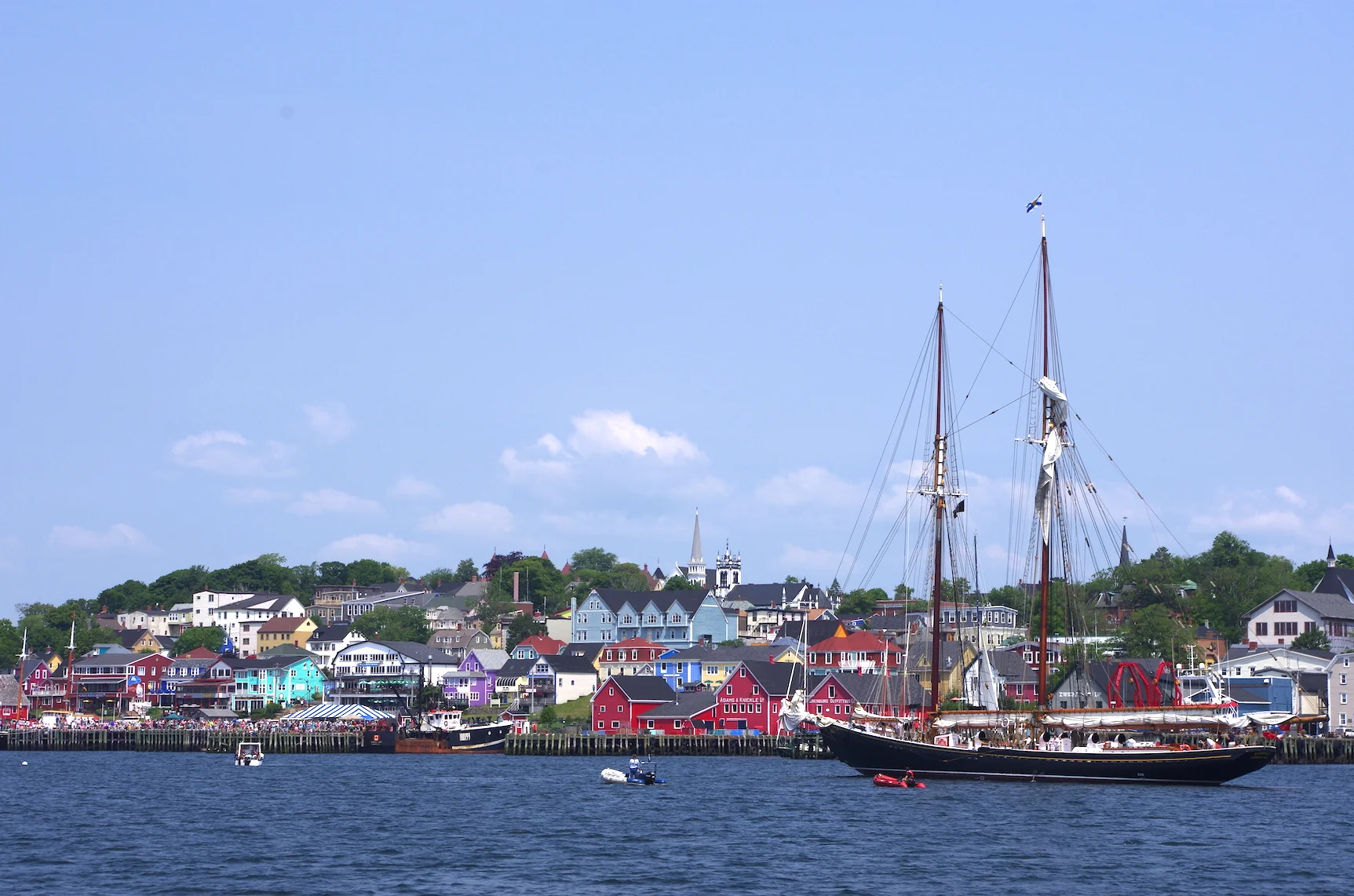
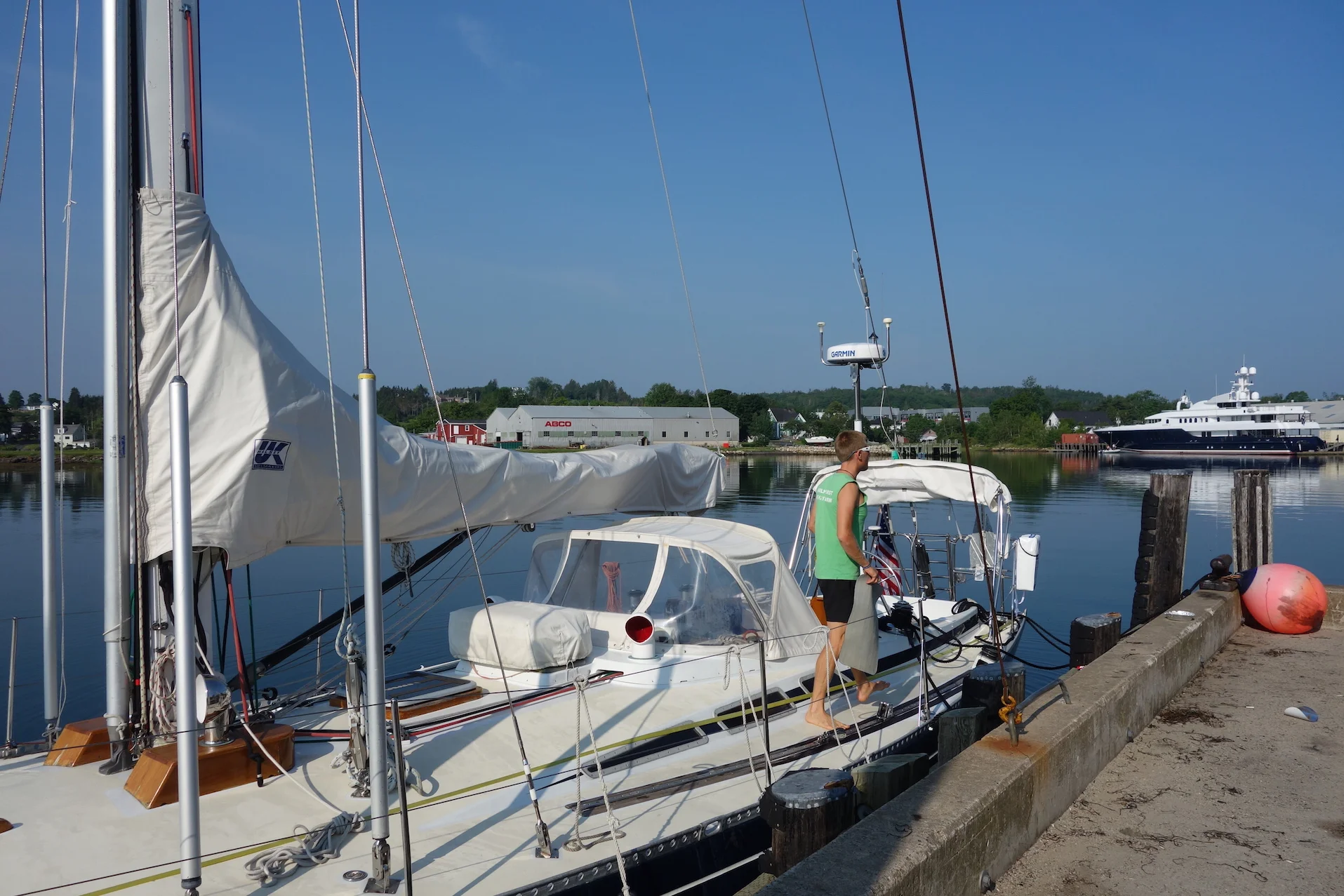
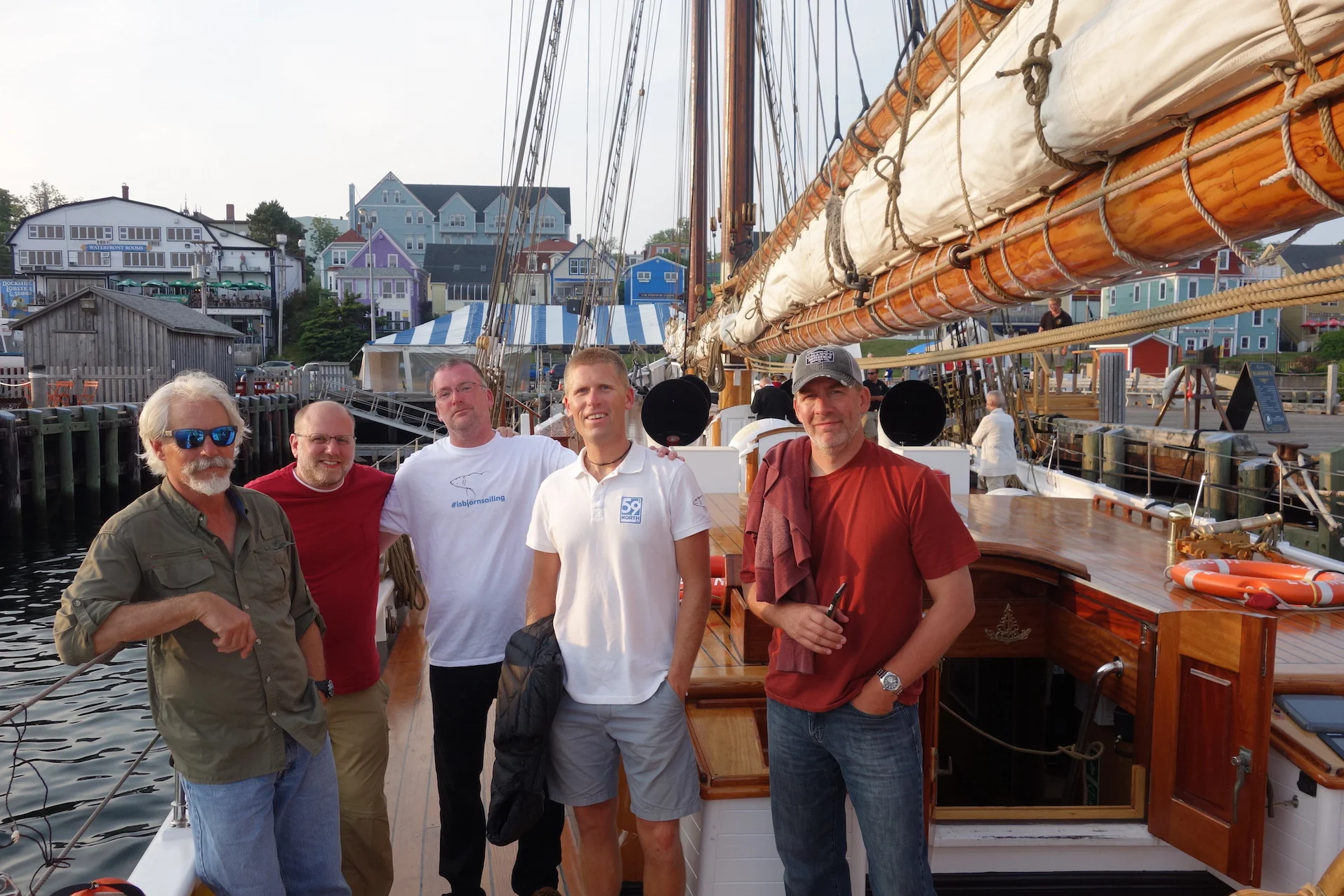
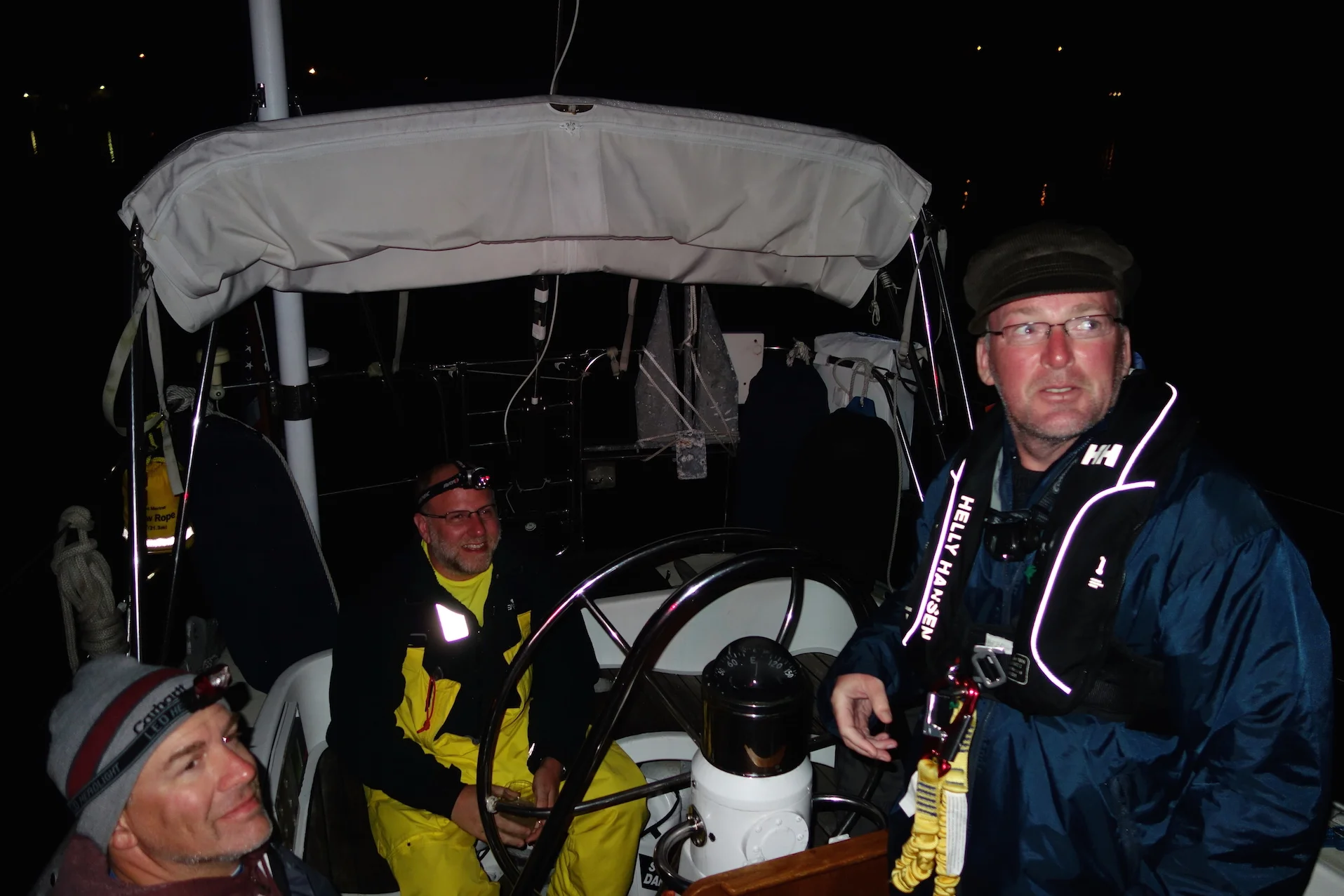
This is the first in a multi-part blog series about Isbjorn's first offshore passage from Annapolis to Lunenburg, Nova Scotia. There are loads of photos in the galleries at the end of each post. Start with this one, and follow along. Normally I do this from at-sea, but we forgot the email device for the sat phone! So here it is now, in one big dump. Some of this I wrote on the boat at-sea, some of it after we arrived. Enjoy! -Andy
Andy and the crew of Isbjörn have no email at sea so they won't be posting blogs while offshore. However, the Yellowbrick tracker can post to Facebook, so check there for brief updates now and then. Also, Isbjörn's position is updated every four hours at 59-north.com/tracking. - Rory
Matt Rutherford's first post of their latest Ocean Research Project voyage to Greenland. Matt and Nicole departed Annapolis last week, and are en route. We'll be posting their blog entries here on 59º North for your adventure reading pleasure. Check out Matt's site at oceanresearchproject.org.
Position 2015.06.15: 39° 34’ N, 072° 11’ W
Mia has informed me that the last article I wrote about our little run-in with the Navy ship was shared something like 22 times on my Facebook page. Apparently it struck a cord with some people, so that's cool. Given that, and having had time to think about what happened some more, I thought I'd type a little followup.
I was sleeping on the port settee, the first time since we started this trip back in NYC that we were on starboard tack and I wasn't hanging in the lee cloth. So a nice cozy sleep, and I was out cold. We'd been motor sailing all night, and the wind was veering around from SW to an expected NE as we passed through a very weak cold front. We we're smack in the Gulf Stream to boot, but starting to make progress again in the right direction.